I Will Build You A Cabin...
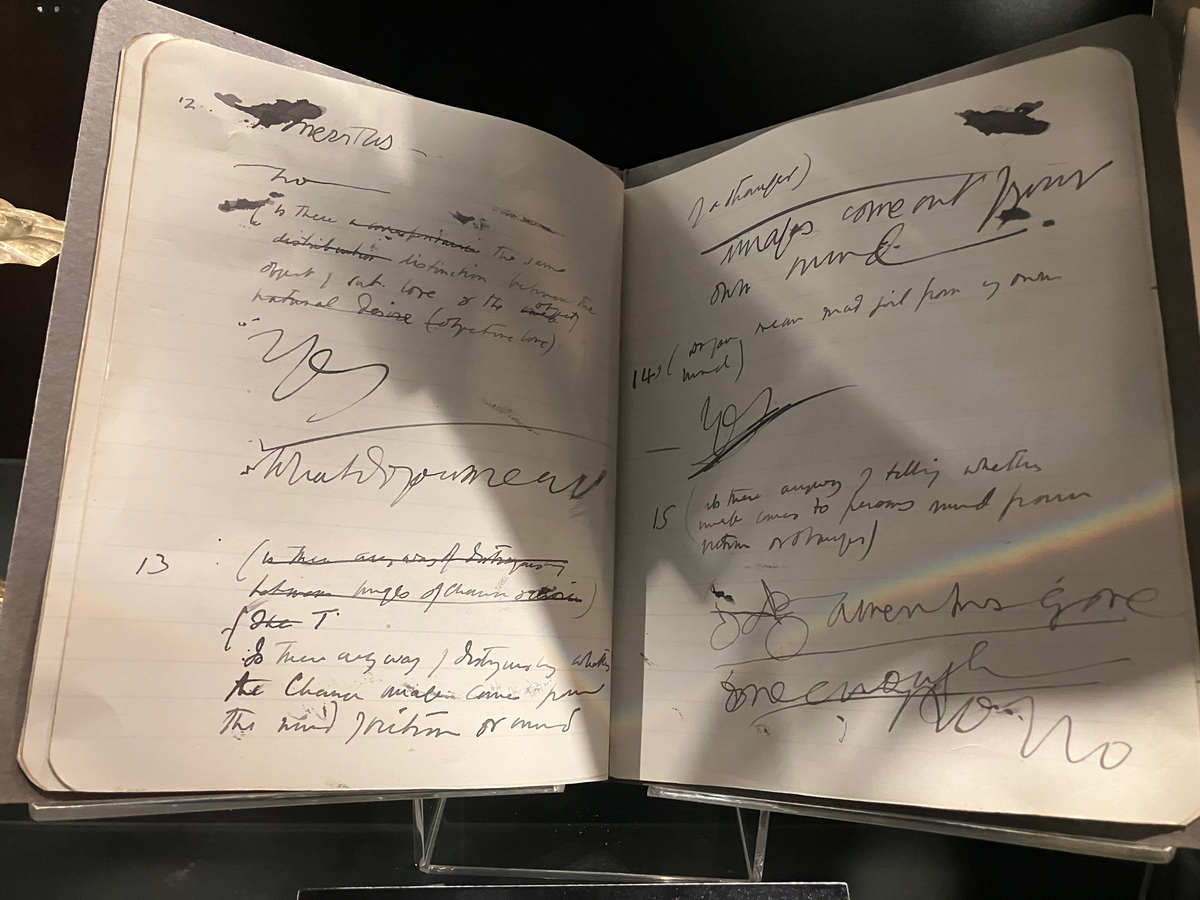
While in Dublin, I dragged my little group to the National Library. Not that they didn't want to go, but I really wanted to go.
When we got there, the guy at the front desk told us that the only thing we could do was go to the little exhibit they had on Yeats. He motioned us down a hallway.
Down the hallway we found a very well curated exhibit on WB Yeats. To say it was a "little" exhibit really undersold it. In beginning of the exhibit they had a screen which showed the text of various WB Yeats poems, including the poem The Lake Isle of Innisfree, which they had a recording of Yeats reading when he was clearly really old.
I made my way around the exhibit, progressing further and further into the history of WB Yeats' life. First I learned that Yeats had two sisters who were incredibly creative but were unfortunately female and therefore relegated to a life history forgot. He also had a brother who was a painter. His brother won an olympic medal for painting, back when that was a thing. But WB Yeats, he is the one who Ireland really canonizes, and like all heroes, WB Yeats had some problems.
WB Yeats, as was fashionable in the late 1800's, was into the occult. The exhibit had books of his and his wife's automatic writings. For those unfamiliar with automatic writing, this is when a person holds a pen and channels spirits, and whatever they write is not from them, but from whatever entity they were channeling.
The automatic writing would have been fine, but the older Yeats got, the more he got into eugenics, and then finally, I came across an exhibit which said the following:
"As WBY drew near to this 70th birthday he felt an inner vigour, despite a lack of good health.
He became interested in Italian fascism and had a brief dalliance with the Blueshirts in Ireland. Linking creative with sexual energy he underwent a 'Steinach operation', a vasectomy thought to be rejuvenating: during this 'second puberty', WBY had several intense friendships with younger women. He collaborated on translations of mystical Hindu writings, campaigned against censorship, set about organising the Irish Academy of Letters, and aroused controversy with his selection of poems for inclusion in The Oxford Book of Modern Verse."
This was one of the more dizzying signs I've seen in a museum. Starting a sign by saying WB Yeats was nearly 70 when he became interested in Italian fascism really made me wonder if there is a doctoral project out there, just waiting to uncover what gene makes certain older men become interested in fascism.
I wandered back to the beginning of the exhibit where I found my husband sitting by the screen watching the text of The Lake Isle of Innisfree roll across some images of lakes and trees. WB Yeats' old man voice warbled through the speakers.
I will arise and go now, and go to Innisfree,
And a small cabin build there, of clay and wattles made;
Nine bean-rows will I have there, a hive for the honey-bee,
And live alone in the bee-loud glade.
My husband looked at me and said, "This poem is amazing."
But all I could think of was WB Yeats writing letters to the Eugenics Society and "getting into Italian fascism".
"I will build you a cabin made of geese and waffles..." I said, my voice a low, rattling drone which was my best approximation of WB Yeats's.
"You're besmirching a Nobel Laureate," my husband said. "You are mocking the country of Ireland."
"I will build you a cabin made of clouds and postage stamps..." I said.
"This is serious," he said, actually getting annoyed.
But all I could think of was the letter I'd read where he asked the Eugenics Society if they found the Irish people inferior.
"I will build you a cabin made of dreams and bubble gum..."
My husband was legitimately annoyed. He got up and left the exhibit. I followed him, our friend, who was also there, followed us, seemingly pretty pleased I had finally left the exhibit.
I passed back by the front desk guy.
"I liked the exhibit," I told him, which I did, even though I wasn't sure what to make of WB Yeats at that point.
He nodded and smiled. I had a second question though. We had spent a few days in Dublin, wandering around, and we knew Ireland was very proud of Joyce, WB Yeats, Bram Stoker and George Bernard Shaw, but one person I hadn't seen anything about was Tana French, who went to Trinity College, lived in Ireland, had won the Irish Book Award, and wrote some of my favorite books of all time, all set in Ireland.
"I haven't seen anything about Tana French while I've been visiting," I said. "But she's an Irish author who has international best sellers."
He looked at me blankly, then finally gave me a one shoulder shrug.
"I don't know her. She must not be that famous," he said.
And I guess all I can say to that is,
I'll build you a cabin made of Irish Book Awards and New York Times Bestsellers,
but you will never, ever be as famous as the author of The Lake Isle of Innisfree.